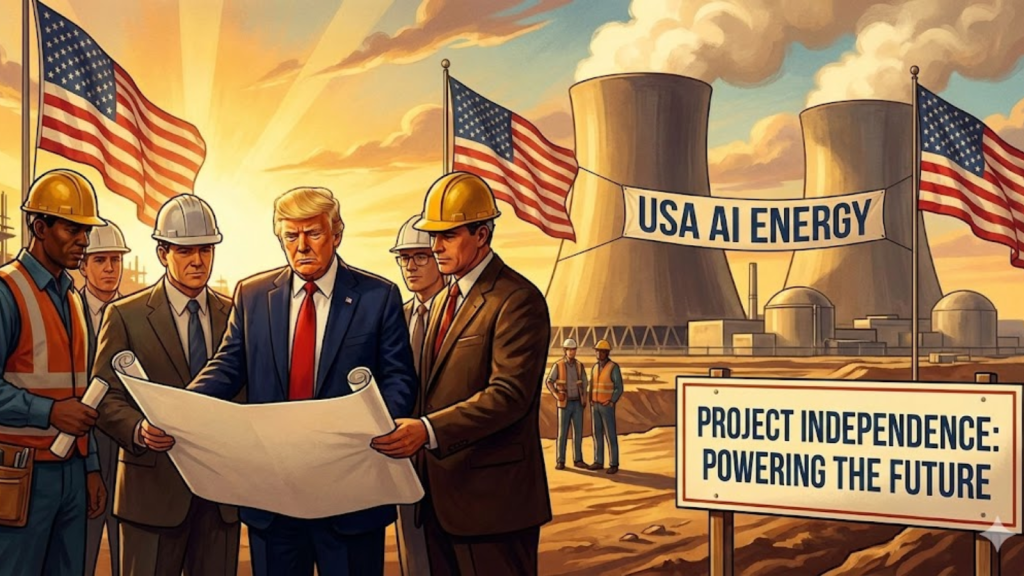
Why This Government-Backed Stock Could Be the Biggest Winner of 2026

They say the free market is dead. And honestly, if you’ve been watching the tape for the last 90 days, you might be inclined to agree.
We are watching the strangest, most profitable contradiction in modern economic history unfold in real time. We have a Republican administration – ostensibly the party of deregulation and “hands-off” economics – engaging in what looks like state-sponsored capitalism.
The federal government is writing checks and taking equity stakes, acting less like a government and more like a venture capitalist with a printing press.
If you’re a purist, you might be horrified. But if you’re an investor who likes making money, you should be thrilled…
Because this new policy has created an almost predictable, explosive pattern in the markets. We’ve seen it happen four times in the last four months.
Intel (INTC). MP Materials (MP). Trilogy Metals (TMQ). Lithium Americas (LAC). All are public stocks. All were targeted by the White House for big investments. And all soared in value after Uncle Sam got positioned.
Now, based on a convergence of signals that are practically screaming at me from my terminal, I believe Shock No. 5 is imminent.
I’ve recorded a brand-new urgent briefing detailing exactly what could be coming next. But before you watch that, I want you to understand why this is happening so that when the news breaks, you aren’t one of the thousands of investors stuck standing on the sidelines.
How Government-Backed Stocks Create Overnight “Shocks”
Let me show you exactly what I mean with the most dramatic example.
Earlier this year, copper and zinc miner Trilogy Metals was a boring company. It had potential; but most Americans had never heard of it. The stock was sleepy, largely trading around $2 per share.
Then, after the closing bell on October 6, 2025, the White House dropped a bomb, announcing a 10% equity stake in the company for $35.6 million.
The next morning, the stock opened at $7.
If you held shares the night before, you woke up to a 211% gain in a single trading session. That is more than the “Magnificent 7” stocks usually make in an entire year, delivered before you’d even finished your morning coffee.
And this wasn’t the first time this year that moves like this sent stocks soaring.
- Shock #1 (July 2025): The Pentagon took a 15% stake in MP Materials to secure rare earth minerals. The stock surged 111% in the week following the news.
- Shock #2 (August 2025): The Pentagon poured $9 billion into Intel. The stock almost doubled over the next three months.
- Shock #3 (September 2025): The government announced it was seeking a 10% stake in Lithium Americas. Shares jumped 194% in the following two weeks.
- Shock #4 (October 2025): The Trilogy Metals explosion – 211% in a day.
Four massive, life-changing stock moves in the span of a few months, all thanks to federal intervention.
The Trump administration has decided that certain assets – like lithium, rare earths, and copper – are too critical to national security to be left to the whims of the open market.
And this federal ‘land grab’ is still in its early stages.
Treasury Secretary Scott Bessent has signaled that the administration has identified at least seven industries it wants to build up. The Financial Times is reporting that “The U.S. is not finished.” And the “One Big Beautiful Bill Act” that just passed earmarked $7.5 billion specifically for critical strategic assets.
My research indicates a massive chunk of that money is heading toward one specific sector…
A sector that is currently facing a crisis so severe, it threatens to derail the entire AI revolution.
The AI Energy Crisis – and Why Nuclear Is the Only Real Solution
I’m on the phone with tech folks constantly. We talk about AI – the opportunities, the headwinds, the bottlenecks.
And the biggest threat is no longer about chips or code. It’s power.
The AI data centers being built right now are ‘energy vampires.’ For example, OpenAI recently announced a $100 billion partnership with Nvidia (NVDA) to build computing infrastructure that requires 10 gigawatts of electricity.
That’s roughly the output of 10 large nuclear power plants – just for one partnership.
Goldman Sachs (GS) predicts data center power demand will jump 50% by 2027 and 165% by 2030.
The grid cannot handle this.
AI facilities need 24/7 baseload power, which, unfortunately, means that renewable energies like solar or wind can’t solve this. They’re intermittent sources that don’t work when the sun sets and the wind dies down.
Battery technology isn’t close enough to bridging the gaps. Fossil fuels are politically difficult for Net-Zero commitments.
That leaves one option – nuclear.
And Big Tech is going all-in.
- Microsoft (MSFT) signed a 20-year power purchase agreement to restart Three Mile Island’s Unit 1 reactor (yes, that Three Mile Island), which will supply 835 megawatts – enough to power roughly 800,000 homes
- Amazon (AMZN) anchored a $500 million investment in X-Energy, a small modular reactor developer, with plans to bring more than 5 gigawatts of nuclear capacity online across multiple projects in Washington and Virginia.
- Alphabet (GOOGL) inked the world’s first corporate agreement to purchase nuclear energy from multiple small modular reactors, ordering up to 500 megawatts from Kairos Power, with the first reactor targeted for 2030.
The government sees this. That’s why, in May 2025, President Trump signed executive orders to “Make Atoms Great Again,” aiming to quadruple nuclear capacity to 400 gigawatts by 2050.
But traditional nuclear plants take 10-plus years to build – and AI can’t wait. Realistically, we need a solution that deploys in two to three years, while also solving the issue of nuclear waste.
And I have found the one company that does both.
Washington’s Open Secret About Nuclear Power
The United States has 90,000 metric tons of nuclear waste sitting in storage. That’s a major liability.
But thanks to its next-gen tech, the company I’ve identified turns spent nuclear waste into fuel. That liability becomes 150 years of clean energy.
Though, as the old saying goes, it’s often not what you know but who you know.
And this company is the most politically connected I have ever seen…
- President Trump’s Energy Secretary is Chris Wright. Since he took over the DOE in January 2025, this company has been selected for three separate pilot programs and granted preferred site access at the Idaho National Laboratory.
- Sam Altman, CEO of OpenAI, backed this company and took it public. For a time, he was chairman of the board. Then, he abruptly stepped down to “avoid a conflict of interest.”
- Think about that. OpenAI needs 10 gigawatts of power. Altman says we need “gargantuan data centers.” Then he steps down from a nuclear power board to avoid a conflict. That tells me a massive deal is coming. He is positioning to buy power from this company, and he had to get out of the boardroom to make the transaction clean.
- There are 37 companies developing advanced nuclear reactors in America. When President Trump held a summit on AI energy, only one from that list was invited to the Oval Office: the CEO of this company.
All of these connections matter.
But if history is any guide, the real money comes to those who get positioned before any official announcement.
The Leak Cycle That Signals Government Investment Ahead of Time
Here is the most urgent part of my message to you today.
When Trilogy Metals popped 211%, it looked like an overnight success. But if you zoomed in on the chart, you saw that in the weeks leading up to the announcement, the stock had already climbed 30%.
When Lithium Americas popped 194%, the stock had drifted up 20% in the 45 days prior.
Why? The Leak Cycle.
Deals this big don’t stay secret. Lawyers talk. Board members position themselves. The “smart money” quietly accumulates shares before the press release hits the wire.
We are seeing those signals right now with this nuclear company:
- A multibillion-dollar partnership with European allies to build fuel infrastructure on American soil
- The largest corporate power agreement in the nuclear sector – 12 gigawatts across hundreds of planned reactors
- A groundbreaking ceremony at a federal research facility attended by cabinet secretaries, governors, and senators
The stock is starting to drift. The volume is picking up.
My analysis suggests an announcement could come in the coming weeks.
And if I’m right, we could be looking at a move that dwarfs Trilogy Metals’ gains – because Trilogy was a $35 million investment in a copper mine. This could be a multi-billion-dollar stake in the foundational energy source for the entire AI economy.
I’m predicting 10X potential here.
Waiting for the Headline Means Missing the Trade
Most investors will wait until they see the headline on CNBC: “White House Announces Billion-Dollar Stake in Nuclear Firm.”
By then, the stock will be up 100% or more. The easy money will be gone.
You have a choice. You can be part of the crowd that gets shocked or part of the group that gets positioned.
My firm identified MP Materials before the Pentagon stake. We identified Lithium Americas before the 194% jump and Trilogy Metals before its 211% explosion.
Now I’m pounding the table on the next move.
I’ve put everything I’ve learned into a new video presentation. It reveals:
- The full analysis of the “Leak Cycle”
- The breakdown of why this company beats the 36 other nuclear contenders
- Details on the “Hedge Plays” (because responsible investing means owning a basket)
- And the name and ticker symbol of this potential 10Xer
Consider the evidence. Decide for yourself. Are Chris Wright and Sam Altman just acting on coincidence… or is the fix in?
Click here to watch that presentation now.